
Post Disclaimer
The content on this site is for informational and educational purposes only and does not constitute medical, legal, or therapeutic advice. I share my own experience and what I have learned along the way, not to suggest what anyone else should do. Some substances discussed on this site are controlled in the United States and other countries. Nothing here should be interpreted as encouragement to engage in illegal activity. Always consult a licensed healthcare professional before making any decisions related to your health or treatment.
Microdosing has become one of the most searched terms in the wellness space over the last few years, and for good reason. It sits at the intersection of ancient plant medicine traditions and cutting-edge neuroscience, and the conversation around it is reaching people who would never have considered psychedelics in any other context.
But the internet can make it hard to sort signal from noise. There is a lot of hype, a lot of oversimplification, and not nearly enough honest conversation about what microdosing actually is, what it is not, and what someone would realistically want to know before exploring it.
That is what this post is for.
What Microdosing Actually Means
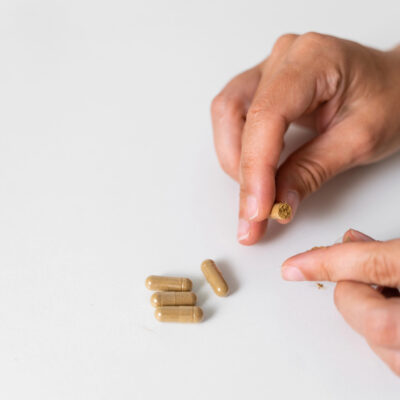
Microdosing means taking a very small, sub-intoxicating dose of a psychedelic substance on a regular schedule. The key word is sub-intoxicating. You are not trying to have a psychedelic experience. You are not tripping. You are taking an amount small enough that you can go about your day normally, while something quieter and more cumulative may be happening underneath.
The goal is not to feel nothing, either. Most people who microdose report noticing something: a little more mental clarity, slightly easier access to emotional states that usually feel far away, a reduced grip of anxiety, or an easier time with focus and creativity. It is subtle. It is not a shortcut. And it works very differently for different people.
How It Differs From a Full Psychedelic Experience
A full psychedelic experience, sometimes called a macrodose or a ceremonial dose, is an entirely different territory. That kind of experience involves a significant alteration in perception, consciousness, and sense of self, and it requires preparation, a safe container, and intentional support before and after.
Microdosing is not that. A microdose is typically around one-tenth to one-twentieth of a full dose, depending on the substance. It is designed to stay well below the threshold of any hallucinatory or perceptual effect. If you are seeing anything unusual or feeling significantly altered, the dose is too high.
This distinction matters because the two approaches serve different purposes and carry very different considerations.
Common Protocols
The most well-known microdosing protocol was developed by researcher James Fadiman and involves one day on followed by two days off, repeated over several weeks. The off days are not wasted time. They are when the nervous system integrates what the on days introduced, and skipping that integration tends to reduce the effectiveness of the practice.
Other protocols exist, including the Stamets Stack, which combines psilocybin with lion’s mane mushroom and niacin and follows a four days on, three days off rhythm. What works varies from person to person, which is one of the reasons having support during a microdosing practice can make a meaningful difference.
What the Research Says
The research on microdosing is still catching up to the anecdotal evidence, but what exists is genuinely promising. Studies out of institutions including Imperial College London and the University of Toronto have shown measurable improvements in mood, focus, and emotional regulation in people who microdose. There is growing interest in microdosing for depression, anxiety, ADHD, OCD, PTSD, and chronic pain.
The leading theory behind these effects involves neuroplasticity: even at sub-perceptual doses, psychedelics appear to encourage the brain to form new connections and move out of the rigid patterns that depression, trauma, and chronic stress create and reinforce over time. For anyone whose nervous system has been in a stuck loop for a long time, that flexibility matters.
It is worth noting that microdosing is not a magic fix, and the research reflects that. It tends to amplify whatever someone is already doing, which means it can just as easily amplify avoidance as it can amplify growth. Intention and support are not optional. The practice is most effective as one piece of a broader approach to healing.
Common Substances Used for Microdosing
Psilocybin mushrooms are the most widely researched and most commonly used substance for microdosing. A typical microdose is around 0.1 to 0.3 grams of dried mushroom. The safety profile is well established, and psilocybin remains federally illegal in the United States, though several cities and states have decriminalized it and Oregon and Colorado have created legal frameworks for supervised access.
LSD is another commonly microdosed substance, with a typical microdose in the range of five to twenty micrograms. LSD tends to produce slightly more energizing effects than psilocybin, though individual responses vary widely. It is also federally illegal in the United States.
Huachuma, also known as San Pedro, is a sacred cactus used in Andean healing traditions for thousands of years. It contains mescaline as its primary active compound and is the substance I focus on in my own microdosing practitioner work. It is less commonly discussed in Western wellness contexts than psilocybin, but its gentle, heart-opening qualities and deep ceremonial lineage make it a meaningful choice for certain people and certain kinds of healing.
What Microdosing Is Not
Because the conversation around microdosing has grown quickly, it has also attracted some unrealistic claims. Microdosing is not a cure for anything. It is not a replacement for therapy, medical treatment, or the slower work of building a life that supports your nervous system. It is not guaranteed to produce any particular result, and it is not right for everyone.
People with a personal or family history of psychosis, schizophrenia, or bipolar disorder should approach this area with significant caution and consult a healthcare provider before considering it. People on certain medications, especially SSRIs and MAOIs, need to work with a knowledgeable provider before exploring any psychedelic practice.
Why Support Matters
One of the most consistent findings across both research and anecdotal reports is that context matters enormously with microdosing. Set and setting, a phrase borrowed from the broader psychedelic world, applies here too. What you are doing with your life around the practice, what intentions you bring, how you are processing what comes up, shapes what the practice actually does.
This is why microdosing coaching exists, and why I do this work. Not because people cannot figure it out on their own, but because having someone alongside you who understands the substance, the protocol, and the emotional terrain makes the practice more effective and more sustainable.
A Note From Me
I came to microdosing after ibogaine, after Bufo, after years of doing the harder and slower work of healing. It did not replace any of that. What it did was add a layer of clarity and presence to an ordinary Tuesday morning that I had not expected to find in something so quiet.
I am now a certified microdosing practitioner, and I work with clients who are navigating trauma, burnout, and the kind of stuck that most conventional tools cannot quite reach. If that sounds like where you are, I would love to talk.

Leave a Reply